
Master BBQ Smoking: Science & Techniques
Ever wondered why your neighbor's brisket tastes so heavenly? Dive into the Science of Barbecue – Smoking Meat to uncover the secrets behind its deliciousness. Learn 'How to smoke meat on a BBQ' and elevate your grilling prowess.
Why Do People Like Smoking Meat?
There are several reasons why people love smoking meat. The first and foremost is that it tastes darn good! Smoking meat is also a fantastic preservation technique that was discovered centuries ago when huts didn’t have chimneys and hunters would hang their meat to dry. Those meats nearer the smoke would preserve better than the dried meats that weren’t. And finally, smoking adds flavour, which also dates back to the ancient days when we began cooking meat over fire. Think of smoking meat as almost a genetic memory. The scent of food cooking over the fire, the smell of smoke, triggers something rather primordial. Though that could just be a grilling enthusiast and confessed meat-a-tarian talking.
Looking for some great smoked recipes to try? We have a bunch for both the charcoal grill and the gas grill!

Don’t Chew the Fat; Melt It!
When you think about it, there are very specific foods that are smoked in preparation for consumption. Meats like ribs, brisket and pork shoulder to name a few. But really, it’s any meat that benefits from a low and slow, long cooking treatment to get the best results. The thing these meats have in common is that they are full of connective tissue. This tissue is filled with collagen. Collagen, when cooked fast, contracts and gains the texture of a rubber band, making your meat tough. But if you smoke or slow-roast something, like a brisket, then the collagen breaks down and melts. While melting, water gets into this collagen and creates gelatin, basically giving you meat Jello, which makes your meal tender, juicy, and flavourful. Triglycerides, or meat fat, are saturated fatty acids found in meat. These fatty acids have high melting points. That means that when you are smoking meats at lower temperatures for longer periods, those fats melt. This process is called rendering, and it is integral to making your meat juicy and flavourful. It is also needed to produce delightful gravies and sauces for other dishes.

Rendering is what happens when fat melts slowly while you are smoking meat or cooking something long, low, and slow. The collagen breaks down and absorbs water, and meat fat melts into the meat fibers making things super tender.
Blowing Smoke Rings
This is all well and good, but what does melting fat and making tender briskets have to do with smoking meat? Smoking is the process by which we achieve the delightful meat Jello and rendered fat. The smoke created from burning hardwood breaks down the cellulose in said wood. This cellulose turns into sugar, which caramelizes, creating flavour. Lignin in wood changes into aromatics, which lend the smoky flavour to your food as well as play the role of a preservative by becoming a coating on the outside of meat that bacteria don’t flourish on.
When you cook any meat, the iron molecules oxidize and turn from red to brown in what is known as the Maillard Reaction. When you smoke, instead of an abundance of oxygen molecules to turn your meat brown, you have carbon dioxide (CO2) and nitric oxide (NO). Instead of oxidizing, the NO molecules bond to the outside of the meat, leaving a beautiful pink ring, because the molecules just happen to be pink.

People Also Asked:
How do you Smoke Meat on a BBQ Grill?
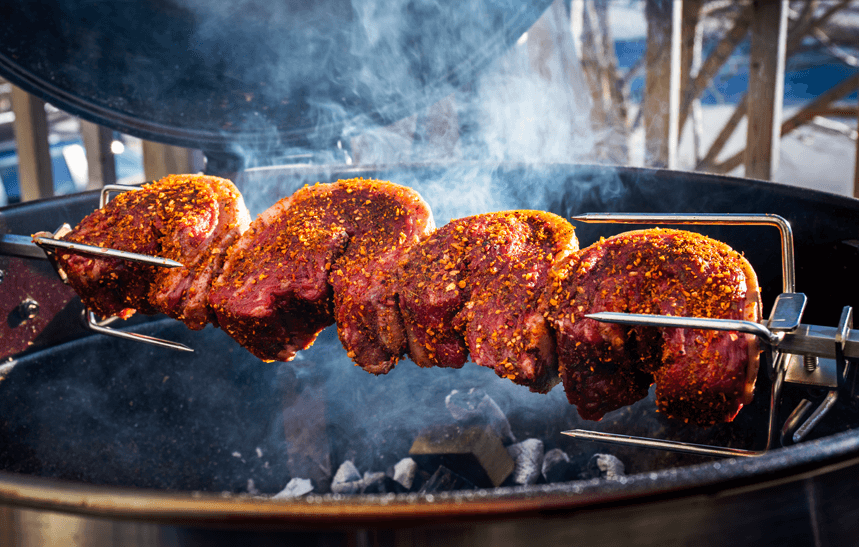
In the most general terms, you need to use wood chips, chunks, or pellets to produce smoke. These can be placed directly into charcoal or use an accessory if you are using a gas grill. You can use a charcoal kettle or a gas grill to smoke and the food that you are smoking dictates the temperatures you need to use. For most larger, low and slow cuts (brisket, ribs, pulled pork) use indirect heat and a general temperature of 225-275°F (107-135°C). Slowly cook until the temperature called for in the recipe is reached.

How Long Does Smoking Meat on a BBQ Grill Take?
The time it takes to smoke something is completely dependent on the cooking method and the size of the cut. If you are just adding smoke to a steak or small roast, higher temperatures can be used and smoking only takes as long as that roast or steak would typically take. If you are slow-smoking a brisket, pork shoulder, or similar, this would be a low and slow smoke. Lower temperatures and smoke will gently cook the meat and require anywhere between 6 and 16+ hours. Reading the recipe in full before starting will give you a good indication of the time smoking will take.
Can you Smoke on a Regular BBQ Grill?
Yes, by setting either your gas BBQ grill or charcoal kettle up with an indirect setup and using an accessory as needed, while adding wood chips, chunks, or pellets and you can smoke meat on a regular BBQ grill. The key is temperature management, which will be dictated by the recipe you are cooking.
How to Smoke Meat on the Barbecue for Beginners?
Everyone starts somewhere. A reliable recipe is the best place to start. You can also check out videos by popular YouTube chefs for guidance. Temperature control is key, and having a good meat thermometer will be beneficial. You can easily add smoke to quicker cooking items like chicken breasts and pork roasts. Add wood chips or chunks and cook with the lid down using indirect heat. For a larger cut like pork shoulder, season with your favourite rub, set your grill to 225-275°F (107-135°C) using indirect heat. Cook to an internal temperature of around 170°F (77°C). Remove it and wrap it in butcher paper or foil. Continue cooking at the same temp without smoke until an internal temperature of 203-205°F (95-96°C). Rest, shred, and serve.
Get Smoky
Bet you didn’t know that the secret to making your next meal the best you have ever had, involved all of this science stuff. But it does, and now you know it too. So, apply this newfound knowledge and smoke yourself the best brisket ever, or make some bacon. You could even pull your pork if you wanted. What’s on your smoker this weekend? Share your smoker recipes, stories and photos with us on social media like our Facebook and Instagram pages using the hashtags #NapoleonEats and #NapoleonGrills.
