

Master Indirect Grilling: Charcoal Grill Tips
When it comes to backyard cooking, few things are as satisfying as the slow, smoky magic of indirect grilling and smoking over charcoal. It’s the method behind righteous ribs, bombastic brisket, and that rich, woodsy flavour we love on everything from trout fresh out of the lake to a good rack of maple-glazed pork. Gas grills might be quick and easy, but there’s a special kind of pride in working with charcoal—the crackle as it lights, the steady heat on a crisp fall afternoon, and that unmistakable aroma drifting through the neighbourhood, making your buddies wander over “just to say hi.” Setting up for indirect heat takes a little know-how, but once you’ve got it, you’ll be turning out feasts that taste like they belong at a cabin up north or a summer family gathering by the lake. Whether you’re settling in for an all-day smoke or a slow roast that’s done before the sun dips, mastering charcoal for indirect grilling and smoking is a skill every Canadian pitmaster should have in their back pocket.
Indirect Grilling on a Charcoal Grill
What is indirect heat on a charcoal grill? Grilling using indirect heat on a charcoal BBQ or smoker is when you ignite charcoal and place it to one side of the grill, creating a space for the food you are cooking that is not directly over those lit coals. Now this seems like an obvious answer; however, sometimes it isn’t that easy. What about smoking? What about grilling a perfect steak over charcoal? You can do that and more using indirect heat on a charcoal grill.

The Easiest Way to Light Charcoal
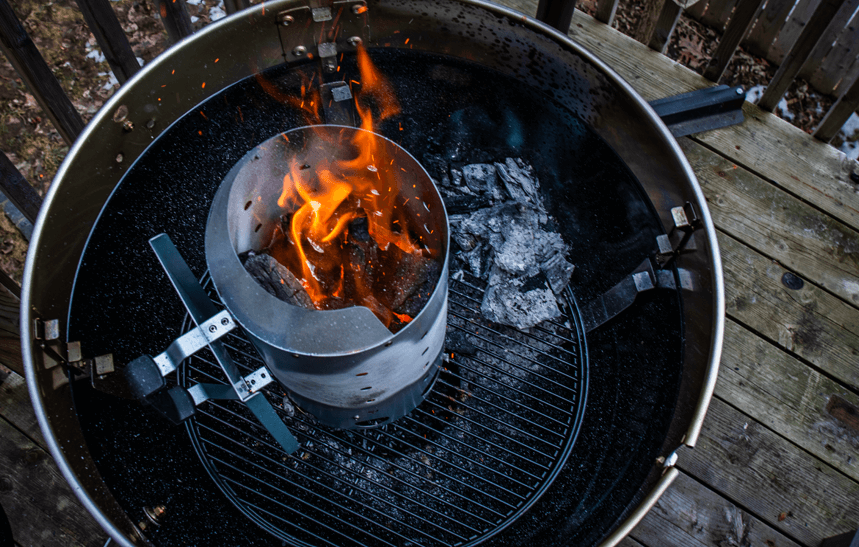
Using a charcoal chimney starter is the easiest way to light charcoal. Place a wad of paper, or a lighter cube under the starter and fill the chimney with the amount of charcoal needed. Light the paper or cube. The fire will ignite the bottom coals while convection and airflow will draw that heat and flame up, lighting the rest. This takes between 10 and 20 minutes.
Two-Zone:
The easiest way to set up your charcoal grill for indirect heat is to light a full load of charcoal and pile the lit coals to one side of the grill, leaving an open space on the opposite side. The benefit of this technique is that you can sear over the coals as well. Imagine slow grilling a steak, maybe adding a little smoke, then searing it off directly over the hot coals for the perfect steak dinner! The two-zone method of charcoal grill setup is the most popular and versatile.
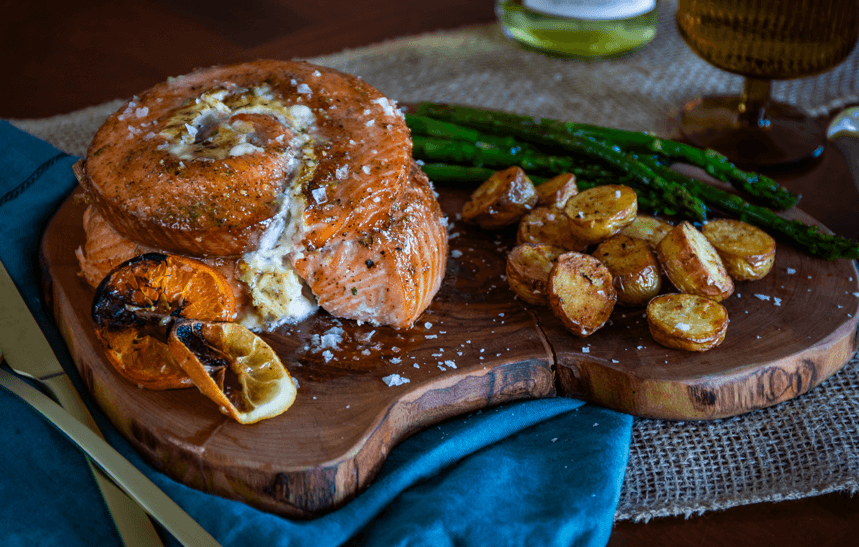
Salmon Pinwheel
Lighter and yet still impressive, this recipe pairs salmon with a creamy filling and smoky flavour.
Parallel With a Pan:
Okay, so that title doesn’t exactly help. Let me try and explain. Light your charcoal, and before you dump it into the grill, place a pan in the middle. That pan can be filled with liquid, be used to catch drippings, or both. Then you pour the charcoal on both sides of the pan. Using charcoal baskets to hold and corral the hot coals is a great way to keep your hot charcoal under control. This is a great technique for when you want to roast something larger, like a turkey or roast of beef, or pork. Food that cooks quickly, like a side of salmon, will get too hot on the sides and dry out.

Snake / Chain / Train Technique:
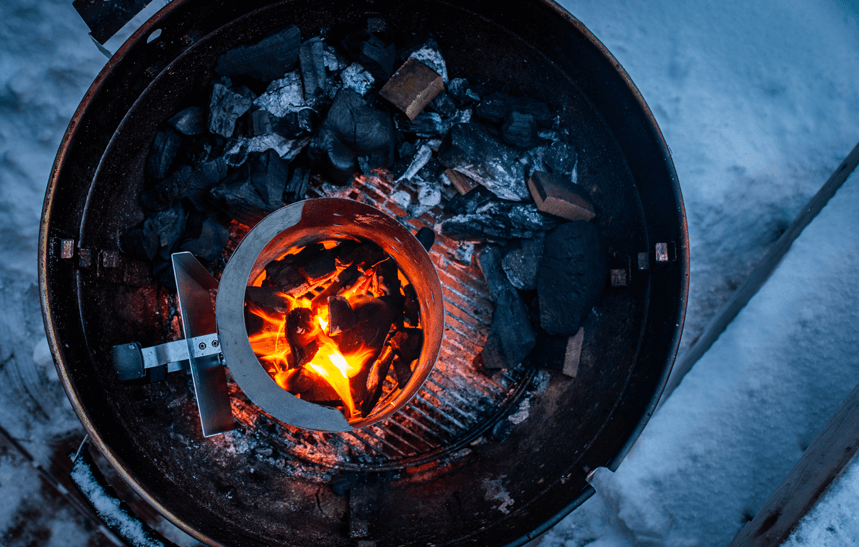
This technique is a little challenging, but it is just as its name says, a snake, chain, or train of charcoal. To set this up, create a semi-circle of unlit charcoal, only two or three chunks wide, around the perimeter of the grill. Light a very small load, ¼ of a chimney will do. Place the lit coals at one end of the charcoal chain. These lit charcoals will light the ones that they touch, and so on. This setup is ideal for extended cooking lasting up to 14 hours.
Turn It Up To 11!
Turn the flavor dial way up by adding smoker chips or chunks to your lit charcoal. This turns your charcoal grill into a smoker instantly so you can pull that pork, rack up the ribs, and get makin’ that bacon!
Bonus Tip!:
Charcoal that has not been consumed can be reused on your next cook. Just make sure to shut all vents on your charcoal barbecue or bullet style smoker when you are done cooking. This chokes the fire and leaves unused charcoal there for your next cook. Just remember to add more fresh charcoal if you are grilling hot or for longer periods so that there is enough to ensure your meal is cooked.
Indirect Grilling on Your Smoker
While you can use your charcoal grill as a smoker, you can also use bullet-style smokers in a similar fashion. Setting this BBQ up for indirect heat is virtually the same as setting up a charcoal kettle grill. Just use one of the three techniques above; however, there can be an optional water pan that you can place above the coals, which is used to help manage temperatures and catch drips. When setting up a smoker for indirect heat, using the two-zone or snake technique is ideal, especially when you are looking at a smoke time of 8 to 16 hours. Place food on any of the stackable layers and make sure that the doors are closed and the latches are secured. Even though your food is on a much higher level, heat still rises; ensure better convection by placing your food over the side of the smoker that doesn’t have charcoal. Don’t forget your favorite flavor of wood chips.

View Our Collection of Wood Chips


Controlling Heat
You can control the heat on a charcoal grill through several different methods. The most important being the air shutter adjustment. Air shutters are found on the bottom of both bullet-style smokers and Charcoal Kettle Grills. You want the air shutter open just enough to let adequate oxygen into the chamber to keep the charcoal lit; one notch on the ash bucket of our Charcoal Kettle Grills, or ¼ of the way open on a bullet smoker.
You can also control heat through the amount of charcoal used. By burning less than a full load of charcoal, you will generate less heat; this is ideal when you are trying to cook at a very low temperature, less than 200°F (93°C). If you need a little more heat and notice that the temperature isn’t getting as high as you want it to, you can always try adjusting air shutters or adding another partial load of charcoal.
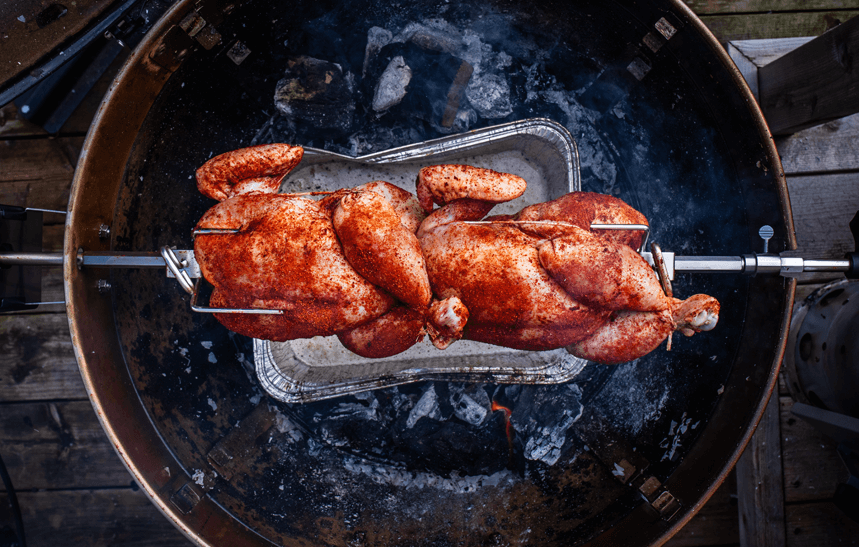
Rotisserie Roasted Charcoal Chicken
Easy and delicious, this Rotisserie Roasted Charcoal Chicken recipe is perfect for both weeknights and the weekend!
Types of Charcoal - Which is Best?
There are many types of charcoal, but determining which is best is completely dependent on what you are cooking.

Briquettes:
Briquettes are uniform in shape and size, which makes them great for consistency. They generally tend to burn hotter and faster than lump, which makes them more suited for direct grilling, but that doesn’t mean you shouldn’t use them if you are trying to use indirect or smoke.

Lump Charcoal:
Lump charcoal is made from wood that has been specially burned to create almost pure carbon. The heat and longevity of burn can differ depending on the wood that was used to create the charcoal, as well as the size and shape of the lumps you get. Smaller shards will be consumed faster than the large lumps, but a good mixture of both can create a great environment for both indirect and direct grilling.

Coconut Charcoal:
Coconut charcoal is interesting. It’s made from coconut byproducts and burns for long periods. Stack a few of these together and you will have a fantastic and easy-to-manage heat source that you can both use to smoke for long periods, or sear over high heat (or both!).
People Also Asked:
How to indirect grill with charcoal?
Indirect grilling with charcoal is when you have a pile of charcoal, which creates a hot and cool zone within your charcoal grill or smoker. There are a few different methods to achieve this, including a pile to one side of the grill, two smaller piles on either side of the grill with a void or a water pan in the middle, or lining the outside of the charcoal grill with a thin layer of unlit charcoal and using a small load of lit charcoal to slowly light the chain from one end.
How to set up a grill for indirect heat?
Whether charcoal or gas grill, setting up a grill for indirect grilling is easy. As long as you have an area of the grill that is not directly heated by charcoal or a burner, you have set up your grill for indirect. Place the food over that unheated area and gently cook for roasted meals, larger cuts of meat, or even when smoking.
Do you open or close the vents on a charcoal grill?
Vents need to be open for a charcoal grill to function. The amount of heat you get depends on the amount of charcoal and oxygen available. The more open a vent is, the more oxygen is available and the hotter a fire will burn. Setting your charcoal grill or smoker’s vents to mostly closed, but still open a little, will provide just enough oxygen to allow an indirect setup to slowly smolder for a while – ideal for smoking or roasting at low temperatures.
What temperature should a grill be at for indirect heat?
This depends on what you are cooking and how it’s being cooked. A grill’s temperature should be set by the end goal of the meal. You wish to smoke something, a grill should be set to between 225°F and 325°F (107°C and 163°C). If you are cooking a roast, reverse searing a steak, or just generally baking, anything around 350°F (177°C) is typical. And if you are cooking something like roasted vegetables or baked potatoes, 400°F (200°C) is normal. Indirect grilling is not just for low and slow.
Share Your Best Low & Slow Grilling Stories
Sure, setting up a charcoal BBQ for indirect heat takes a little more effort than firing up your gas BBQ, but that’s part of the fun, and the reward is well worth it. From slow-smoked salmon to a roast that’s so tender it practically falls apart, the results speak for themselves. So, we’re curious; when you’re cooking low and slow, are you reaching for your gas BBQ or firing up the charcoal? Share your stories, photos, and maybe even a few of your favourite tips with us on Facebook and Instagram using the hashtags #NapoleonEats and #NapoleonGrills. We can’t wait to see what’s cooking in your backyard.
Show us what you are grilling
Join the #NapoleonEats Community on Social



#NapoleonEats
@NapoleonProducts